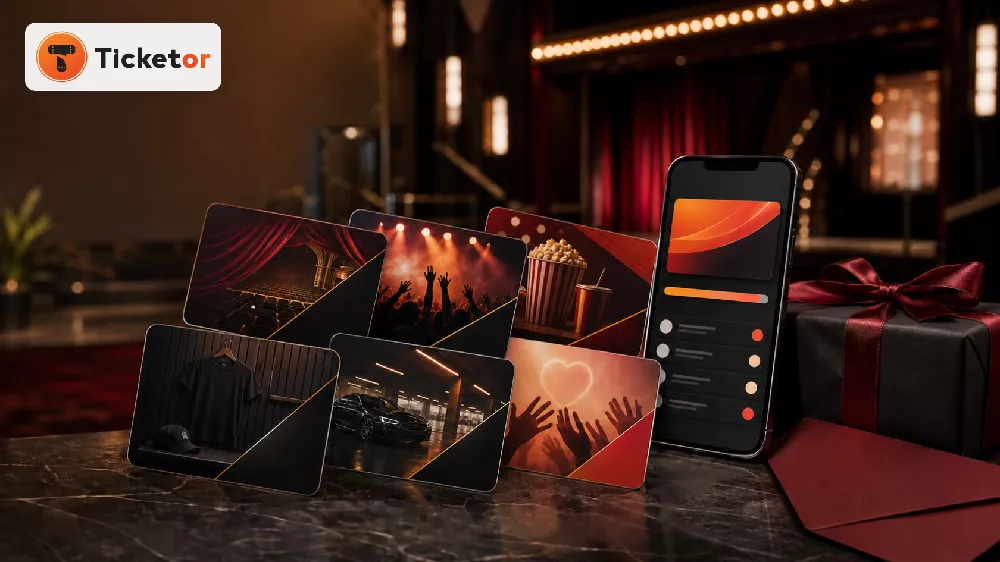
One Gift Card for Your Entire Venue: Tickets, Merchandise, Concessions and More
A gift card should be more than a code that discounts one ticket order. For a theater, venue, or event organization, it can be advance cash flow, a branded invitation to a new patron, and a flexible balance that brings someone back for a future performance.
The challenge is usually the system behind the card. Staff should not have to create every card manually, maintain balances in a spreadsheet, or reconcile a separate gift-card provider with ticket sales. Buyers should not need one card for admission and another for everything else the organization sells.
Ticketor includes a full-featured gift-card system inside the same account used for ticketing and box-office operations. You design the products and decide where they apply. Ticketor then handles online and POS sales, automatic issuance, redemption, remaining balances, and transaction history in the connected purchase flow.
The result is one gift-card program for your organization—not another disconnected system for your staff to manage.
Offer preset values, a custom amount, or both
Preset amounts make purchasing quick. A theater might offer $25, $50, $100, and $200 cards, while a family attraction may choose amounts that align with common admission packages. Each value can be a separate product with its own name, sales price, description, and artwork.
Ticketor also supports custom-amount gift cards. Enable Allow buyer to enter a custom gift card amount, and the buyer chooses the value before adding the card to the cart. This works well for group gifts, corporate appreciation, school communities, and patrons who want to cover a particular experience without being limited to a few denominations.
You can combine both approaches. Keep familiar preset values for fast holiday shopping and add one custom-value option for buyers who need flexibility.
Gift cards may also be sold below face value as a promotion. For example, an organization can offer a $100 card for $90 during a limited campaign. The sales price and card value remain distinct, so the promotion is clear and the recipient still receives the intended spending balance.
Put your design on the gift—not the software company's
A gift card is a small piece of advertising that one patron gives to another. It should look like it came from your theater, venue, team, festival, school, or nonprofit.
Ticketor lets you upload an image that appears on the gift card. You can create multiple products with different designs for birthdays, holidays, opening night, a concert series, a fundraiser, or a seasonal campaign. A performing-arts center might offer separate designs for theater, dance, and music while keeping every card in the same balance system.
Buyers receive the card with its name, artwork, value, and unique code. The card can be printed or downloaded as an image and shared electronically. Ticketor also includes a numeric code and scannable code for redemption, so attractive presentation does not come at the cost of practical box-office use.
This is white-label gifting in the useful sense: your artwork reaches the recipient, while the accounting and redemption logic stays connected to the rest of your operation.
Automate the purchase, issuance, and delivery
Once the gift-card products are configured, patrons can purchase them from your online store without requiring staff involvement. They can buy one card or several, and gift cards can be purchased in the same cart as tickets, merchandise, or donations.
After a successful purchase, Ticketor issues the electronic gift card automatically. The buyer receives access to the printable and downloadable card and can give its code to the recipient. There is no separate spreadsheet entry, manually generated certificate number, or follow-up email that staff must remember to send.
Gift cards can also be sold from Ticketor POS. That gives the box office, gift shop, or another authorized sales location a way to issue cards for people who prefer to buy in person. Organizations can create a dedicated online gift-card page, include the products in a broader store, organize them by category, and control the dates when seasonal products are offered.
You can also promote selected cards in Ticketor's pre-checkout flow. A buyer purchasing event tickets can be invited to add a gift card before completing the order, without sending them to a separate website or payment process.
One organization-wide balance for everything you sell
The strongest gift card is useful after the recipient arrives. A card that only works for one narrow product creates unnecessary restrictions; a balance that works across the organization gives the recipient a reason to explore.
An administrator can create a Ticketor gift card that applies across the site. The recipient can use it toward eligible products sold through that organization, including:
- Event tickets and assigned seats
- Merchandise and gift-shop products
- Food, drinks, and concessions
- Parking passes or other items offered through the Ticketor store
- Donations and fundraising purchases
- Other eligible products or services included in the same checkout
This is especially useful for venues that are more than a ticket window. A recipient can choose the performance, buy a shirt, reserve parking, order refreshments, or support a campaign using the same stored value.
Organizations that host outside producers can also use narrower gift-card scopes. A card may be associated with a particular event organizer instead of the whole site. That distinction keeps the program flexible: issue a venue-wide card when the organization owns the complete experience, or an organizer-specific card when funds need to stay with one producer.
Use several gift cards on one invoice—or one card on several invoices
Real gift giving rarely arrives in perfectly matched totals. A family may give someone two cards, or a recipient may have a small balance left from an earlier visit.
Ticketor lets a buyer apply multiple gift cards to one checkout. If the cards do not cover the invoice, the buyer pays the remainder using an available online payment method. At the POS, authorized staff can apply gift cards and collect the remaining amount through the configured in-person methods.
The reverse works too. A gift card does not have to be consumed in one transaction. If a patron uses $35 from a $100 card, the remaining $65 stays on that card. The same code can be used on later purchases until the balance reaches zero.
That flexibility matters for season-long relationships. A recipient might use part of a card for a performance in the fall, another part for concessions, and the rest toward a spring event. One card can participate in several invoices while maintaining a single balance and history.
Online, the buyer enters the numeric gift-card code during checkout. At the box office, staff can enter the code or scan it into the gift-card field. The same card and balance work across both channels.
Give buyers and staff a clear gift-card statement
A reliable gift-card program needs a ledger, not just a list of codes.
Ticketor administrators can view issued gift cards, search for a card, and see its original amount and current balance. Opening a card shows the transactions recorded against it, creating a usable statement for researching redemptions or answering a patron's question.
Buyers can sign in and open My Gift Cards to see their cards, remaining balances, and transaction history. They can also print or download their cards again. That self-service access reduces routine balance inquiries and gives the cardholder confidence about what was used and what remains.
Because issuance, ticket purchases, merchandise, concessions, donations, and POS activity can stay in one Ticketor account, staff do not have to compare unrelated reports just to understand how a balance moved.
Turn advance cash flow into a long-term patron relationship
Gift cards provide cash before the associated visit happens. That can help an organization bring money forward into holiday periods, fundraising campaigns, or quieter sales months. For accounting purposes, however, advance cash is not necessarily the same as immediately earned revenue; the unredeemed amount may remain a liability until redemption or another legally permitted recognition event.
The marketing value can be just as important. A loyal patron chooses the gift, but the recipient may be someone who has never attended your venue. The card arrives as a personal recommendation with your artwork on it. Instead of advertising an individual event that may not fit the recipient's schedule, you give that person the freedom to discover the organization and choose what interests them.
Redemption also creates natural cross-selling opportunities. Someone who received a card for tickets may discover a concert series, add concessions, browse merchandise, purchase parking, or contribute to a donation campaign. If the order costs more than the remaining balance, the recipient can complete the difference using another supported payment method.
Gift cards can support repeat attendance as well. A remaining balance is a reason to return to the site, review upcoming events, and make another purchase. The card stays connected to the patron's account and statement rather than disappearing after one use.
Handle unused and expired balances responsibly
Some gift cards are never redeemed in full. The unredeemed portion is commonly called breakage. It may eventually benefit the organization, but it should not be described or booked as automatic "free money."
Recognition of unused balances depends on accounting standards, tax treatment, the card terms, consumer-protection rules, and unclaimed-property laws. In some jurisdictions, remaining value may need to stay available for years or be reported and remitted as unclaimed property. Organizations should establish their accounting treatment with a qualified adviser.
Ticketor allows an organization to configure a gift card to expire after a chosen period or to have no expiration. The setting must follow the laws that apply to the issuer and purchaser. In the United States, federal rules generally require covered gift-card funds to remain valid for at least five years, and some states provide longer or stronger protections. The Consumer Financial Protection Bureau's current gift-card rule explains the federal baseline; it is not a substitute for state-specific or international advice.
A good policy balances business needs with buyer confidence. Make the terms visible, choose an expiration period only when permitted, and avoid surprising a recipient who reasonably expects the value to remain usable.
A practical launch checklist
Before publishing your first gift cards, decide:
- Will the card work across the whole organization or only for one event organizer?
- Which preset values make sense, and will buyers also have a custom-amount option?
- Which artwork will represent your brand and seasonal campaigns?
- Will the sales price equal the card value, or will any cards be offered as a promotion?
- Where will buyers discover the cards: a dedicated page, your store, the box office, or pre-checkout suggestions?
- Should the cards expire, and has that policy been reviewed for the relevant laws and accounting treatment?
- Do staff know how to sell, scan, redeem, and look up a gift-card statement in POS?
- Who will review issued balances, redemption history, and outstanding liabilities?
The operational details are documented in Ticketor's gift-card setup and management guide.
One connected system, from gift to final balance
Ticketor gives theaters, venues, and event organizations the pieces of a complete gift-card program: preset and custom amounts, your artwork, automated online issuance, in-person sales, flexible redemption, partial balances, multiple-card checkout, buyer statements, and administrative reporting.
More importantly, the card belongs to the same commerce system as the experiences and products it can purchase. Your staff manage one connected account, and the recipient gets one balance that can follow them across the organization.
Explore Ticketor's integrated gift-card system and see how it can support your venue, theater, or event organization.
